COULSDON COLLEGE: MEDIA TEXT INFORMATION
SHEET
|
||||||||||||||
TITLE:
|
Inglorious Bastards
|
YEAR OF PROD:
|
2013
|
|||||||||||
TYPE:
|
FILM
X
|
TELEVISION
|
DOC.
|
MUSIC
|
ADVERT
|
MUSIC
VID.
|
OTHER:
|
|||||||
DIRECTOR
|
Quentin Tarantino, Eli Roth
|
PRODUCER
|
||||||||||||
WRITER
|
Quentin Tarantino
|
PRODUCTION COMPANY
|
Universal Pictures, Weinstein Company
|
|||||||||||
KEY CAST
/ARTIST
|
Brad Pitt, Diane Kruger, Eli Roth
|
|||||||||||||
KEY CREW
|
Eli Roth, Brad Pitt
|
|||||||||||||
GENRE
|
Adventure, Drama, War
|
BUDGET
|
$75,000,000
|
BOX OFFICE
|
$120,523,073
|
|||||||||
THEMES
|
||||||||||||||
AWARDS
|
||||||||||||||
NARRATIVE:
In Nazi-occupied France, young Jewish refugee Shosanna Dreyfus witnesses the slaughter of her family by Colonel Hans Landa. Narrowly escaping with her life, she plots her revenge several years later when German war hero Fredrick Zoller takes a rapid interest in her and arranges an illustrious movie premiere at the theater she now runs. With the promise of every major Nazi officer in attendance, the event catches the attention of the "Basterds", a group of Jewish-American guerrilla soldiers led by the ruthless Lt. Aldo Raine. As the relentless executioners advance and the conspiring young girl's plans are set in motion, their paths will cross for a fateful evening that will shake the very annals of history.
|
||||||||||||||
KEY SCENES:
|
||||||||||||||
COMPARABLES:
|
||||||||||||||
PROGRESSION OF KEY
CONTRIBUTORS:
|
||||||||||||||
ANY OTHER BUSINESS?
|
||||||||||||||
Tuesday, 23 February 2016
Inglorious Bastards and Miracle at St. Anna comparison

The Man from Nowhere - 1500 words, final draft
The scene I am going to write about in my film is where the
protagonist, CHA Tae-shik, right after being shot with a pistol, while in agony
being treated for his wound he experiences a flashback into his cruel but
gentle past, where he is seen as young and clean going to visit his girlfriend
who is pregnant with his child. The Man From Nowhere had been produced by Cinema Service, Opus Pictures, United Pictures and was directed by Lee Jung
Boem and been released for Korean cinema in 2010 belonging to the crime, action
and thriller genre. In this scene, Tae-sik attempts to struggle and rescue his young and only friend, So-mi, he takes So-mi for the reincarnation of his unborn daughter, murdered along with his wife in retaliation for his work as a special operative and assassin for the Korean government.
The non diegetic background music adds to the scene to generate an effect of suspense and tension within the audience as this is a crucial turning point in the protagonist’s life in the film. The soundtrack additionally goes well with the scene as it makes the audience understand how significant the tension and seriousness of conflict between the Korean mafia and the protagonist’s current affairs are, as the director uses the non diegetic sound to highlight this.
Straight away from entering this flashback, it’s extremely
noticeable how the colour scheme changes in the scene of the flashback compared
to the rest of the film from the exterior. There is a clear use of bright colours,
especially on the furniture in the hospital and the shopping store. The use of
the bright colours while in the hospital gives off the meaning that at that
present time, the protagonist was experiencing the most positive moment of his
life with the one person he loves the most. Additionally, there is frequent use
of white colours in this setting which symbolizes peace and proximity which
adds to the mood while also representing the new life that had been due to be
born.


The colour of the car that his girlfriend is waiting in is also white,
along with- the babies clothes he purchases in the store which also relates to
the colour scheme of the environment used here. The frequent use of white
colours definitely has a calming effect on us and reaches out to us on an
emotional level: such as the ironic feeling of love in this scene, protection,
humility, innocent, youth and kindness. These themes are also explored
throughout this film and within this scene. The lighting here also symbolizes life
and is used coherently along with the bright colours which works well along
with the setting and environment inside the hospital building and shopping
store.
However this can be taken very differently due to the widely
different cultures and therefore separate audiences to cater to. Unlike in
Western culture where the colour white symbolizes peace and purity, the use of
white colours in Eastern culture, white is considered to be a colour that
represents death. The colour white led to its traditional use as the
traditional colour of mourning. Considering this is a Korean film, this
audience may have taken these hints as an incident related to death that was
about to occur. This is a very smart
technique that the director, Lee Jung-Beom has employed that gives a deeper
meaning than just using an ordinary colour for no deeper reasoning.
The low angle close up shot of the detectives shoes as they’re
walking shows how important the people are even before showing the audience
what they look like. This is to display a dominance of power within these stock
characters also this is a way that Lee Jung Boem can introduce them simply
through their performance and mise en scene of the detectives walking at a busy
pace as a group with formal suits on, along with the cinematography of the low
angle shot to symbolize dominance and importance.

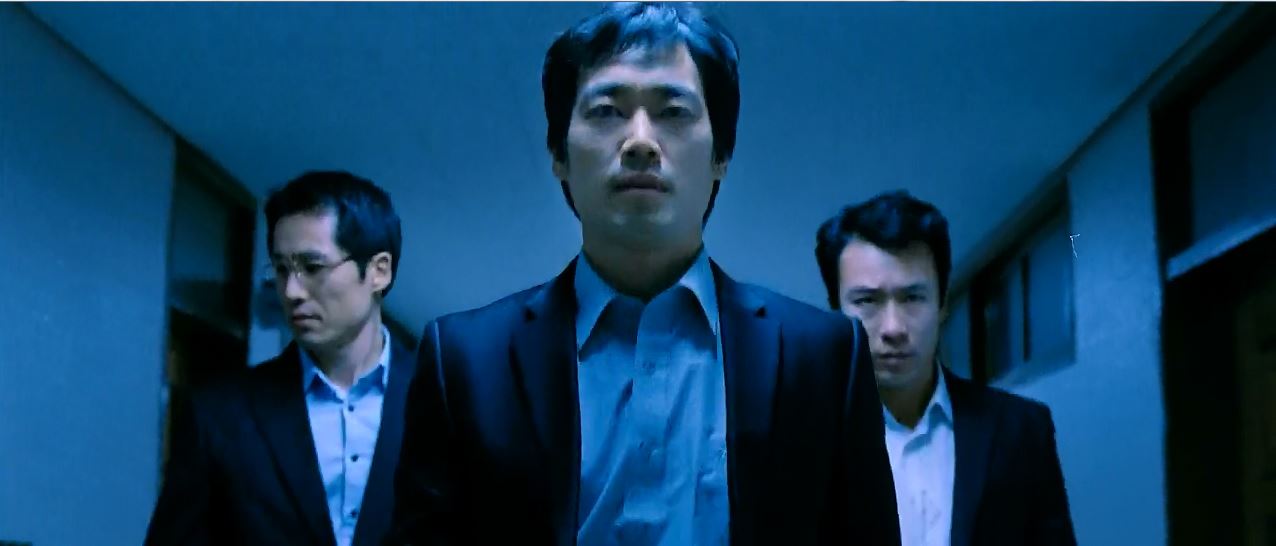
His hair is also appeared to look long and unhygienic, which
shows how he doesn’t care much for his life right now until he has a purpose to
live. Compared to the flashback scene, Tae-shik looks very clean and positive
compared to his negative vibe on his other appearance. He has a calm sense of
ease to himself and looks like he could cause no harm to anyone at all. On the
other hand, throughout the first half of the film up until this flashback, the
way the protagonist is portrayed creates the mood that death is always lurking
over him, how he attracts danger everywhere he goes which was also the cause of
his pregnant wife’s death and also symbolizes how he is regretful about how he
lived his life so far up towards the end of this flashback.

I believe that during the scene where Tae-shik walks over to
his girlfriend and sits down with her, he asks to hug “both of you” (yet-to-be
born child), once he hugs them we see a trimester scan photo of his child. He
has the photo scan in his hands and we see a close up shot of him grasping the
photo with force to the point where it creases up, foreshadowing that an
unpleasant incident involving the unborn child is going to occur. This action
is also relevant to the murder of his wife, who gets crushed by a truck driven
at full speed. The cinematography used
in these scenes works excellent accordingly to the transition into the
protagonists past. As he is undergoing surgery to ta
ke out the bullet from his
stomach at the beginning of the scene, a close up shot is used on his face to
show the pain and how traumatizing the experience is to him because of the same
experience he faced long ago which ties into this scene here. The close up is
also shot on his face in order to show his facial expression and portray his
current emotions to make us, the audience, feel involved and share his current
sense of sorrow and . As the camera focuses on the protagonists facial
expression as he is in pain from undergoing emergency surgery, the
cinematography in this scene creates a swirl effect to generate an accurate
representation of the pain the protagonist is going through. This is an effective
technique that the director employs as he is intending to portray the
protagonists emotions to the audience through cinematography techniques as well
as use of performance.

Overall the cinematography and mise en scene are all
effectively used to address the scenario and portray the themes of hope,
vengeance, suffering and redemption of The Man from Nowhere.
Monday, 8 February 2016

Monday, 30 November 2015
Film Analysis: 71
The British film industry never found a Vietnam-type genre in the violence of Northern Ireland, maybe because there wasn’t the same sense of us and them: the republicans were never as far-off and exotically faceless as Hollywood considered the Viet Cong to be. But this traumatic era – almost over, but not quite – might yet prove a rich seam. Screenwriter Gregory Burke and first-time feature director Yann Demange have made a cracking movie debut with ’71, a behind-enemy-lines war movie reeking with bad blood and bad faith, perhaps best described as an action-conspiracy thriller. It is interestingly free of the tone that dramas about the Troubles traditionally assume: a tone that you might call tragical correctness.
The film is set in west Belfast in the early years of the conflict, a year before Bloody Sunday; a time when Northern Ireland was still routinely referred to on television news as “the province”, like an outpost of the Roman empire.
Its central figure is played by Jack O’Connell, a terrific actor with the charisma of a young Albert Finney. He is Gary, an English lad from Derbyshire who has joined the Parachute Regiment, and who perhaps finds in the army the comforts of a replacement family. At the beginning of the decade, he is shipped out to Belfast, where the army must participate in the fiction of being merely present to assist the civilian police (the Royal Ulster Constabulary, as they were then called) in their duties, rather than directly imposing martial law.
A house-to-house search off the Falls Road goes horribly wrong; the resulting confrontation triggers a riot situation in which Gary is left behind by his retreating unit. He finds himself in a no-man’s-land where that well-honed phrase “the enemy within” appears to apply both to friend and foe. It is a world in which the authorities are running high-level informers and supplying arms to loyalist paramilitaries to maintain a deniable, proxy war. Gary’s commanding officer, Lt Armitage (Sam Reid), finds himself at odds with the furtive, plain-clothes intelligence operative Captain Browning (Sean Harris); and the Provisionals’ fiercely committed Haggerty (Martin McCann) and the eerily blank-faced Sean (Barry Keoghan) are plotting against their own chiefs. Meanwhile, a former army doctor on the republican side may be Gary’s only chance: he is Eamon, played by Richard Dormer (notable for his excellent portrayal of Terri Hooley, the punk music promoter in Good Vibrations).
Tuesday, 24 November 2015
Post It - Short film - Analysis
The short
film posted on YouTube titled ‘Post It’ was released in 2014, directed and both
written by Michael Evans. Produced by ‘Go For Broke Films’, this independent
short film gained a lot of recognition on social networking sites which had
made it gain attention to distributors around the world to be released in
various countries, most notably Japan by the distributor ‘Pacific Voice Inc.’
To add to the film’s success, this film also won the third best place for the
title of ‘Best Screenplay’ at the UNLV Spring Flicks film festival. The short
film is a comedy followed along with the directors aim to make the audience
laugh coming from a rather saddening opening to the film to the introduction of
the post-it notes to act as a purpose for the two protagonists Elroy and Clare
to interact together and spread their happiness to other strangers who look
like they need it or deserve it. The narrative also follows a simplistic linear
narrative storyline seamlessly as the plot avoids confusion.
The film
also incorporates themes and sub-genres of romance, backed up through the
cinematography techniques such as the two shot of the two protagonists of the
film conversing on the bench to generate a interest in each other along with
the non-diegetic background music to create a mutual mood between the two that
the director wants to convey through both the performance and sound delivered
through the visual and audio codes. The title sequence at the beginning of the
film that’s used to present who the production company is, the editing used to
display the production companies ident is written on a post it note using
visual effects which connote what the narrative is going to be about before the
film has even started.
The use of
lighting is well employed by the director in this film because it is used in a
way where it helps the audience understand what mood or state of mind the
protagonist is in or coming out from. A scene where this is presented is in the
first scene where Elroy is exiting a building from the main entrance. His back
is turned coming through the door facing the opposite view of the camera,
exiting a darkly lit building. This could mean that Elroy is being troubled by
something or is facing a harsh time in his life which is emphasized through the
technical codes for example Elroy carrying a heavy object as to bear these
burdens that acts as a metaphor in the film. The sound used here adds to the
depressing mood of the shot. As Elroy walks out of the shot towards the camera,
the light brightens on him to suggest the escape from
Elroy’s
character is performed superbly as it feels natural viewing the film from an
audience standpoint, however I feel that Claire’s performance is too forced as
the director makes her seem unnatural the way she keeps intriguing on Elroy’s
personal life and invading his personal space while creating an unrealistic
attempt of interacting with the protagonist which in turn makes myself and the
audience deviate from the film as the performance of the actor is undeniably too
‘acted’ out.
-- Finish
Sunday, 22 November 2015
Film Analysis - Short Film - One Minute Time Machine
One-Minute
Time Machine is a short film directed by Devon Avery and written by Sean
Crouch. This film was actually created on a very short budget of $1,000 USD,
produced by the production company ‘Empty Box Productions’ and won seven wins
and three nominations as an independent film. The film has gained a surge in
popularity on the video sharing website, ‘YouTube’, which went viral and
amassed 2.9m viewers. The genre for this film is comedy and romance due to the
comedic and romantic elements retaining from the two contrasting characters and
the object that brings their encounter together, the one minute time machine. However
I could also argue that this short film does harbor sci-fi elements which lead
to this film’s sub-genre, science fiction, judging from the main subject of the
film that’s used that is a fictional time machine.

Themes
explored within this short film include happiness and lusts, deriving from the
failed attempts of James’ pick-up lines resorting to using time travel to
restart the communication between the two in an attempt of trying to initiate
sexual chemistry between Regina and himself, thus leading to a potential
relationship. However as the narrative continues to progress, James is unaware
of his actions from continuous attempts of pressing the red button on the one
minute time machine to go back in time, which leads to the downfall of the
protagonist until Regina takes control of the time machine. Here she uses it
against him in favour of bringing him back to his past self. I feel that the
director uses this narrative technique as a great plot device to keep changing
back the plot, making it stay on the course of what the audience wants.
At the
beginning of the film we are introduced to the title sequence which states the film’s
title along with the audio codes, the non-diegetic sound of a piano melody is
there in order to create an upbringing positive mood which is a convention o

Right after
the title sequence a two shot is shown of both the actors within the film,
James and Regina. This type of shot is taken to show the contrast between the
two, while there to take note of what type of clothing the characters are
wearing which foreshadows what personality they both have and what object they’re
holding, lastly what environment the film is set in. From this shot alone we
can notice from the visual codes that James is wearing a casual style of
clothes that connote his casual
personality while Regina has the smart look to possibly show dominance in the
future conversation that they have and has a further emphasis her social status
in society. From this we can presume she is on her work break and James has
free time on his hands, not busy at all.

Both
protagonists carry an object with them from the start of the film that would
act as an important asset for the narrative of the film later on. The book is
used as a tool for both Regina and James to relate to each other throughout the
film, as the book she was reading is a science book based on time travelling,
while coincidentally James uses a time travelling device with the motive to
possibly fulfill his sexual desires.
This film is
therefore a non-linear narrative as the basis of the film is to continuously manipulate
time and space, ultimately leading to a chain of past and future events that
have already taken place within the films world.
Thursday, 19 November 2015
Visual Effects Artist - Alan Clappison - Presentation Thoughts
Guest: Alan Clappison
I was quite
surprised that someone who had worked on many famous films such as the recent
sci-fi film, The Martian, which was distributed to local cinema’s such as Vue
(where I watched it), came in to Coulsdon College out of his presumed busy
schedule to teach us about what it’s like working in the VFX sector in the Film
industry. This was extremely intriguing for me as I was deeply interested in
what techniques and programs he uses for his work and learning about the route
he took to break into the film industry as a whole. Alan had explained the
various types of 3D modelling programs that he uses, since I’m familiar with
the program ‘Cinema4D’, I know that they use this in the film industry. However
I was quite mistaken as when I had asked Al, he told me that the program ‘Maya’
was the default program that they use in the VFX industry; though Cinema4D isn’t
completed blown out the water.

Guardians
of the galaxy was another film that he worked on and had detailed how tedious
it was to render out using hundreds of computers and showed us a clip of the
development and animation of the CGI created characters. Finally he made a
presentation about different aspects of Visual Effects and what different skill
sets and techniques industries require such as the Video Game industry or even
just commission editing for businesses. His speech and presentation was well
laid out and I liked how we got the free opportunity to ask him questions
throughout his time in class.

[Guadians of the Galaxy 3D concept - Autodesk Maya]
Subscribe to:
Posts (Atom)