On the 7th of October, we went to go and watch six of the short films showcased at the BFI located in South Bank, London. As we got there I noticed that they have their own library right on the left side of where you can purchase tickets and also a free film cinema where anyone can watch films with practically no cost at all. I thought that was very intriguing but since it's free I didn't really think that the films they were showing were of a decent narrative and standard of quality. The seats in the British Film Institute were extremely comfortable and I never felt the need to stand up due to discomfort.
On the following day, 8th of October, we went to go see a full length film called Ayanda at the Cineworld cinema in Haymarket. The film is a romantic drama set in South Africa based around the life of a girl who lost her father and want's to persue her dream in the shadow of her desceased father. The seats in the cineworld cinema I found were uncomfortable and was really dissatisfied because it made me feel like I had the same experience as my local vue cinema located in the Croydon town centre.
Wednesday, 14 October 2015
SOFT VS WASP
SOFT vs WASP
Soft is a short film directed and written
by Simon Ellis and is about a father who is forced to confront his fears at the
worst possible time in front of his own son who he poses as a role model to.
The film’s genre is social realism because of the many realistic aspects of
society that occur during the film. Crime is also one of the genres due to
youth delinquents causing terror to a vulnerable family. Themes that occur
around this film are fear, anguish, hate, terror and humility. These themes are
explored throughout the film and the director embraces them to create tension
and a sense of unease for the viewer.
Wasp is also a short film however directed
and written by another producer, Andrea Arnold, who has also directed another
film in the same genre that’s extremely similar to Soft and Wasp; which is Fish
Tank. Wasp is about a mother who lives in poverty, struggling to look after her
children as a single parent. However an old potential lover enters her life,
which forces her into a situation where she constantly has to choose the
priority over him or her children. Both short films are very similar in regard
to the genre of social realism and the reoccurring themes.
However what’s to take note of is the technical and visual
codes in wasp. The big difference in both films and what I especially liked is
how the editor used the visual effects of the insects to create symbolism of
how the children are no different than insects trying to survive off of food
left over on the street. This technique was employed extremely well because it
contrasts and teaches the audience how poor some people are in England.
Tuesday, 13 October 2015
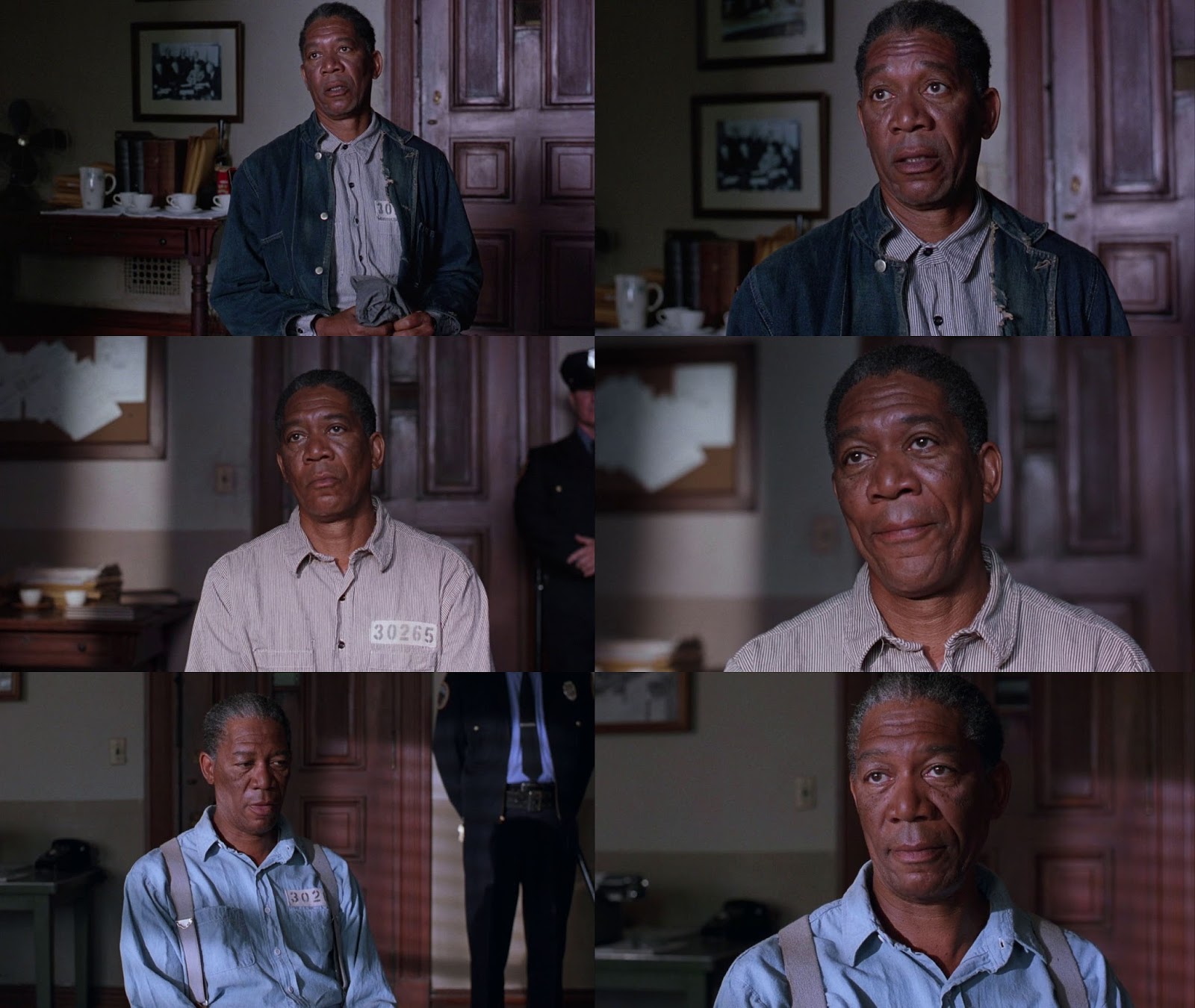
The Shawshank Redemption - Analysis
The Shawshank redemption is a superb film directed by Frank
Darabont and written by Stephen King. What’s noticeable about this film is the
writer is a famous author known for his globally successful books, with up to
350 million book copies sold worldwide. Back when the film was released in
1994, advertisements that would have had Stephen King’s name on them simply
would have been a no-brainer for the public to watch. Hence this is why I
contemplate the films outstanding success, for the reason being of Stephen
King’s narrative for the film. The summary of the film introduces us to Andy Dufresne (Tim Robbins), a sharp banker falsely sentenced to two life terms for the double-murder of his wife and the man she was cheating with. He’s sent to Shawshank State Prison in 1947 and the film revolves around his life from this point forward.
Taking into account the reoccurring events based around
criminal activity and given that the film is set inside a prison, the obvious
genre that the Shawshank redemption falls into is crime. This brings us into
the themes of the film. I feel that the main theme that this film focuses
around is ‘hope’ which ties into the religious themes this film inhabits due to
all of the prisoners using the bible as a guidance on how to live and how the
writer and director attempts to depict the protagonist as a false prophet
looking for a miracle. Another theme explored is rehabilitation, as the film
preaches forgiveness with its religious themes, I believe that it preaches
second chances with is sociological themes. The film makes you adore and like
the characters who are in fact criminals who have murdered innocent people,
which makes us believe that people can be rehabilitated and actually teaches us
a lesson to forgive as an example as we lead on with our own lives and may come
across similar situations where someone has changed from a mistake they've once
committed in their lives and learnt from that.
The use of religious themes is backed up by examples as the
protagonist gathering convicted inmates to follow his guidance and look up to
him, similar to the prophet Jesus and his twelve disciples. The character who
dialogues the film, RED, also describes his escape from his jail cell as a
miracle when stated earlier on in the film that it’s impossible to escape. Once
Andy escapes the prison he’s seen travel through a sewage tunnel and once out, looks
upon the sky in freedom while rain falls down on him, signifying hope and
relates to the scene in the bible where Jesus calls upon God on the night
before he is captured by the Roman soldiers. This also ironically relates to
the resurrection of Jesus as they both finally become free after enduring
similar yet different journeys in their life.
The narrative of this film is told in a oral narrative
style, where the actor, Morgan Freeman who plays RED, provides dialogue/narrates
throughout the film to recount a sequence of events, essentially telling the
audience the life of the protagonist, Andy Dufresne’s sentence time in the
prison. I believe that Stephen King, the writer, chose this method of telling
the story because of how easy it makes the storytelling be and refrains from
confusing the audience with the amount of time skips that occurs in the film.
Performance in this film is without flaw. Every actor who
plays a character creates a strong personality that we can love but also hate.
I believe the only non-digetic sound in the Shawshank
redemption is the narrators voice throughout the film and the punch sound
effects in the scenes where Andy is being harassed and beaten up to engage in
homosexual activity.
Most of the cinematography is used to express the various
characters emotions and facial expressions using close up shots of the face.
Close up and mid shots are very common in this film when a conversation is occurring because
the photographer, Roger Deakins, wants the viewer to get to know the characters
on the same level as the people they are conversing with. He does an excellent
job at this as it made me feel engaged during the film and feel sympathy for these characters even though having prior knowledge on their bad deeds when in turn should make you hate and resent them. Without the frequent use of close ups, it wouldn’t make the film feel as personal as it truly is.
Monday, 12 October 2015
Soft ANALYSIS w/ notes
Soft Analysis
Soft is a short film that tells a realistic drama about a
group of delinquents harassing a family that doesn’t want to be burdened. The plot mainly focuses around a father that
is forced to confront his fears and tries to confront them in order to protect
his son. The film was directed and written by Simon Ellis and released in 2007
with a budget estimated of 50,000. Considering the big budget for the short
film, I suspect that this was a big contributing factor to the films success
and without a doubt this film looks like it could’ve been produced on a lower
budget due to the short length and video quality at times in the film. Soft has
won numerous awards, most notably one BAFTA film award which goes to show how
high standard this film is.
The many themes explored in this short film have a lot to do
with fear, anger, anxiety and humility. Soft’s genre is fairly obvious to point
out as it’s social realism with drama as it focuses around what occurs in the
majority of peoples everyday life. Throughout the film, there are many scenes
in which it leaves the audience feeling tense, always on edge about what’s upcoming.
Tension is a huge part of this film as it keeps us engaged and leads to
shocking events such as when the father’s son strikes the delinquents in the
head with a baseball bat.
The cinematography in Soft is outstanding as it is used to
depict different perspectives throughout the whole film. The aspect ratio and quality
of resolution always changes constantly when the camera focuses on either of
the two different social groups. I feel that the director had used this
technique to give an insight to the audience on the huge gap in the quality of
life from the delinquents and the father and son, this is a good representation
of how these people live and generates a view of what life is like between
lower class people and people from a middle class standpoint.
Sunday, 11 October 2015
Get off my land ANALYSIS
The short film titled “Get off my land” is a film about a
presumed couple exploring the countryside but intruding on a man’s property,
hence the title. We, the audience, gather the assumption that the man and the
woman who are the main protagonists of the short film are a couple, judging
from how comfortable they are together while arguing and how the man always
tries to lighten the mood while she’s annoyed. I believe that the film is
actually set in the countryside however one could also argue that the setting
could be near or in someone’s farm due to the gate that they both try to get
through. If it was a normal park or countryside then you would be able to
easily unlock the gate due to the gate being intended for humans to use; the
gate we see here resembles one that’s used to prevent animals from getting out
the farm, therefore we can presume that the film is being shot in the
antagonists’ farm.
The mise en scene in this film provides the audience with a
lot of information as to who is acting what role and how what we see creates
meaning and supplies us with knowledge on why it’s there such as the props or
the costumes for example. From what we notice from the first clip of the short
film, the woman is wearing boots and suitable trousers walking through the mud.
Then we see the man behind her, who is wearing casual clothing (jeans and
shoes), has a lot of trouble even just walking across the muddy ground. This
supports my theory as evidence as to how the couple might have had an argument
even before they might have reached the muddy plains, that is the major
difference in clothing. This also broadens our view on who must have been the
right one from the conflict between the two; assuming the woman is wearing the
right clothing for the trip and the man is wearing the wrong unsuitable clothing.
Just judging from what the characters are wearing, the audience can notice what
type of personalities these characters have. From just the clip where the man
dusts off the mud from his jeans, we immediately know that the character is
impatient and believes he’s rough from what we can tell from his body language.
The woman walks straight forward across the mud which indicates that she’s
tired of him and suggests she knows what she’s doing, the positioning of the
characters also creates meaning that they are currently unhappy with each other
and shows us the conflict between the two.
The cinematography
used in this short film is executed very well to present what’s happening in
the film. The wide shot of the man trying to cross the gate is used to generate
certain emotions such as making the audience feel awkward and confused that the
man is struggling to cross this giant obstacle while the woman who we presume
is his partner just looks and walks off in the distance. This shot makes the
audience feel as how much he is trying to take an effort to initiate contact
between the woman and makes us feel disgust as to how the woman is treating
him. Without this wide shot we wouldn’t be able to understand what the director
wants to convey to the audience and how the gate is used as a metaphor as to
how big the next obstacle is going to become and is there as a warning to how one shouldn’t trespass into someone else’s
property.
I really liked how the director, Douglas Ray, employed the
long shot camera technique right before the man and the woman engages
communication with the antagonist in the jeep. The way Douglas had shot this scene;
he places the camera onto the field and keeps the camera moving slightly
unsteady. The reason why I admired this scene out of the whole short film was
because of the effect that this shot gives off the audience. It made me feel as
if someone is watching them from a far off distance, or how it reminds me of an
animal disguised within the environment seeking its prey; the shot gives the
effect of how they are being hunted.
What’s rather noticing is the jeep coming out from the trees
in the big field. From this shot I realize that this type of vehicle is not one
you would see in the city and if so, it would be a rare occurrence to see one.
The vehicle is shown in the shot to show that they are not close to the city,
and that the setting is far off from modern civilization.
The non-digetic sound in this film is used from the sound of
the gun shots as they obviously couldn’t fire the gun on video. The second gun
shot is edited into the film to foreshadow that the woman had been killed too,
however the audience is left to theorize what actually happened so the death of
the woman is not certain. As the gun shot is fired, we see an extreme long shot
of birds flying out of the trees. This symbolizes death as animals are
frightened of loud noises, with the addition of the birds being crows which is
a symbolism for bad luck.
Ralph analysis
Ralph
In ‘Ralph’
the first scene we see is the character stepping off the train. The camera shot
is distinctively obvious as it’s a long shot. In addition, the character,
Ralph, is significantly smaller in size compared to the many other objects
around him such as the vehicles and the current setting. This tells us that at
first glance Ralph is a tourist who is lost and trying to navigate to a
location that he is unsure about. At
times the jitter cam is often used in scenes where Ralph is in a conversation
with someone or unsure about what to do. Using this technique, it gives us the
audience the implication that Ralph is at unease because everyone is different
around him and is in disarray due to the fact that he can’t find the person
he’s looking for. This also adds realism to the film as it seems as if we, the
audience are there with him.
The props in
the mis’en scene actually have a deep role that relates to the actor in the
short film. Normally when people try to call other people, they use a fairly
small mobile phone for contact. However in this short film the director chose
to use a pay phone with a phone that was much bigger than usual. I could say
that the director chose to use this because Ralph is in dire need of help and
because he has a big problem, the phone is meant to empower how big his
situation currently is. The editing in this film is minimal, but works well in
terms of when each scene is cut. This doesn’t make it seem like the clip order
is random which would confuse the audience; the camera shot order is executed
very well. In the short film, Ralph seems to constantly go through a continuity
of problems throughout his fairly short journey while in France. Ralph has a
pen and paper with him, which he uses to write down a series of telephone
numbers in order to try and get into contact with his lost friend. This
signifies how much of a problem his struggle is and how much he is willing to
go through in order to achieve it.
During the
film, most of the characters are speaking a foreign language, which leaves the
audience baffled as to what’s going on and what’s being said. However this is
also used to our advantage as it leaves it up to us to decide what’s going on
and what is going to happen further on in the film. This also applies to when
Ralph sometimes doesn’t make any speeches in reply to others trying to talk to
him in a different language. This makes it quite exciting to watch and keeps us
occupied as it leaves it up to us to decide whether he’s going to catch up with
Clare or not.
There are
many themes that occur such as him being lost, confusion, despair, love and
jealousy to name a few. All these themes link up with one another to help us
focus about the plot of the film. However it’s quite difficult for the average
person to try and notice what genre the film is from first glance. In my
opinion, I’d say this is an Adventure film due to the adventure the main
character Ralph is having, with various other elements such as suspense,
anxiety and being self aware of his surroundings.
The ending
of the film is surprisingly very well executed, as it includes a plot twist to
when Ralph finally meets the person he has been meaning to contact, but rather
has made short contact with another woman and chooses to disregard all that
hard work in order to try and find the character ‘Clare’ and just go off with
the woman he just met.
Monday, 5 October 2015
Fish Tank analysis with comparison with Wasp
Right from the beginning of the film, the audience
learns who funded the film, who the producers are and if there are any other
sponsors. These are all presented to us from the company logos. As for the film
‘Fish Tank’, before the film starts and from the credits at the end we can see
that the producers of the film are the UK Film council, Limelight
Communication, Kontent Film who is also in association with Limelight and
Kassander Film company. The director and writer of Fish Tank is coincidentally
the same person who directed and wrote the short film ‘Wasp’; Andrea Arnold.
However this is to be expected as both films share many similarities between
the two. The protagonists in both the films experience the same poverty ridden
lifestyles from what we gather of how they live in a first would country, the
behaviour that both of them exhibit is shunned upon in our society but the
same. However both of their situations are fairly opposite but also similar in
a sense where they are both involved in romance but a certain impetus conflicts
The setting where most of the film is shot and set is
filmed in a sub urban area which incorporates many rural buildings and estate
flats. From the establishing shot of where the protagonist Mia
lives, the audience gathers information about the narrative of the film
which we can tell that the plot is going to revolve around the troubled youth
and teenage delinquents of today’s modern society and suggests the low quality
of life the protagonist experiences throughout her life. From what the audience
gathers, the residents living in the estate exhibit rebellious behaviour such
as drinking alcohol without much clothing on and playing loud negative urban
music which further enhances what state of mind Mia and her neighbours/friends
have; the tattoos on some of the other cast also highlights the how rough the
society she lives in. This is an effective way of providing hints to the
audience as to what’s going to happen later on in the film thus also
foreshadowing future evets which suggests she is going to have a discouraging
future ahead of her. The desaturated colours of the environment and flats shows
that where the protagonist lives is a filthy environment that only the minority
of less fortunate people live in which indicates what kind of experience the
audience will get from watching the film, Fish Tank. From this, the audience
can figure out what type of genre this film leads into; which is social
realism.
Cinematography techniques are astounding to indulge
the audience into feeling like they are there with Mia on her journey. The
handheld camera is used to try and make this effective as possible, for example
when she is walking somewhere or if the camera is mainly focused on her at
times this camera technique is used to feel like the audience is there with
her. Such as seen in the beginning of the film from the start after the title
sequences up until the end, the handheld camera is always being predominantly
used for the realistic effect. Her general mood and situation gives the
audience a feeling as to feel like she’s in prison, which is also backed up by
the camera shot of the horse through the gate; resembling a animal in a cage.
As for the mise en scene, In a few scenes throughout
the film, a grey horse is seen locked up in an abandoned site that’s now run by
thieves. Mia tries countless times to free the horse from captivity, but fails
to do so. There is great symbolism here as what Mia is wearing when she first
goes there, her clothes are the same colour as the horses skin, grey. I
believe that she keeps trying to free this horse because she doesn’t want the
horse to go through what she is currently experiencing, thus the colour scheme
of her tracksuit matches the horse which symbolises that they are the same,
just different circumstances. This is also another technical code that’s
similar to the same technical codes Arnold used in her short film Wasp. As
mentioned before, the insects are compared with the children to make it seem
like they’re in the same situation or practically the same status.
The film focuses a lot on the protagonist’s individual
lifestyle; I feel that the director Andrea Arnold was trying to convey a
message through the technical codes that she employs. For instance the extreme
long shot where Mia was sitting down in the middle of an open field with her
head on her arms in a childlike position where one would seem troubled suggests
that she is lonely and on her own, how no one is going to help her and she’s
struggling all by herself in order to try and have a glim of light to act as a
sign of hope for her future. The lighting especially signifies how lost and
lonely she is due to the use of dark lighting with the addition of the sky
being abnormally more pitch black than a usual sky, due to editing techniques,
she is trying to put more emphasis on the characters loneliness. These codes
are there to create meaning in the moving images of the film, which are used a
lot in the short film Wasp. Such as when the protagonist of the film’s children
have nothing to eat and therefore have to gather left over food that has been
thrown away on the streets, then the film transitions to bugs feeding off of
the food as well clearly implies that the children and the insects are treated
the same way, where the director tries to show how similar these poor children
are compared to insects. This is how this scene creates meaning through the
visual aspects.
We often see Mia dancing around in an empty room by
herself that looks like it hasn’t been rented in a long time, presumably a
vacant place where homeless people sometimes sleep judging by the worn
mattresses placed next to a radiator. The first time we see this place, the
lighting used is significantly dark so the director uses low-key lighting to
generate an understanding of how she feels each time she goes there and
back. As she keeps going back throughout the film, she dances there which gives
us the idea that this is the only place where the protagonist can seek
happiness. The lighting changes during these scenes over time as the brightness
of the lighting goes up, this suggets that her mood heightens as she becomes
enlightened each time she is there.
Overall the film’s narrative is told In an order of
how Mia is going through times of hardship and how she tries to live a better
life through the means of a potential lover but also a fatherly figure at the
same time. The film tells the audience how she would deal with these aspects,
considering her status in society. I like how the film is directed and shot,
especially the use of the handheld camera to make us feel like we are there,
however I would of preferred the use of the point of view camera in certain
scenes to add to the realistic aspect of the film to generate a more practical
approach of the audience being fully involved to get a better understanding of
how Mia feels throughout the film.
Subscribe to:
Posts (Atom)